Johnny B. Bad by Stephanie Bennett
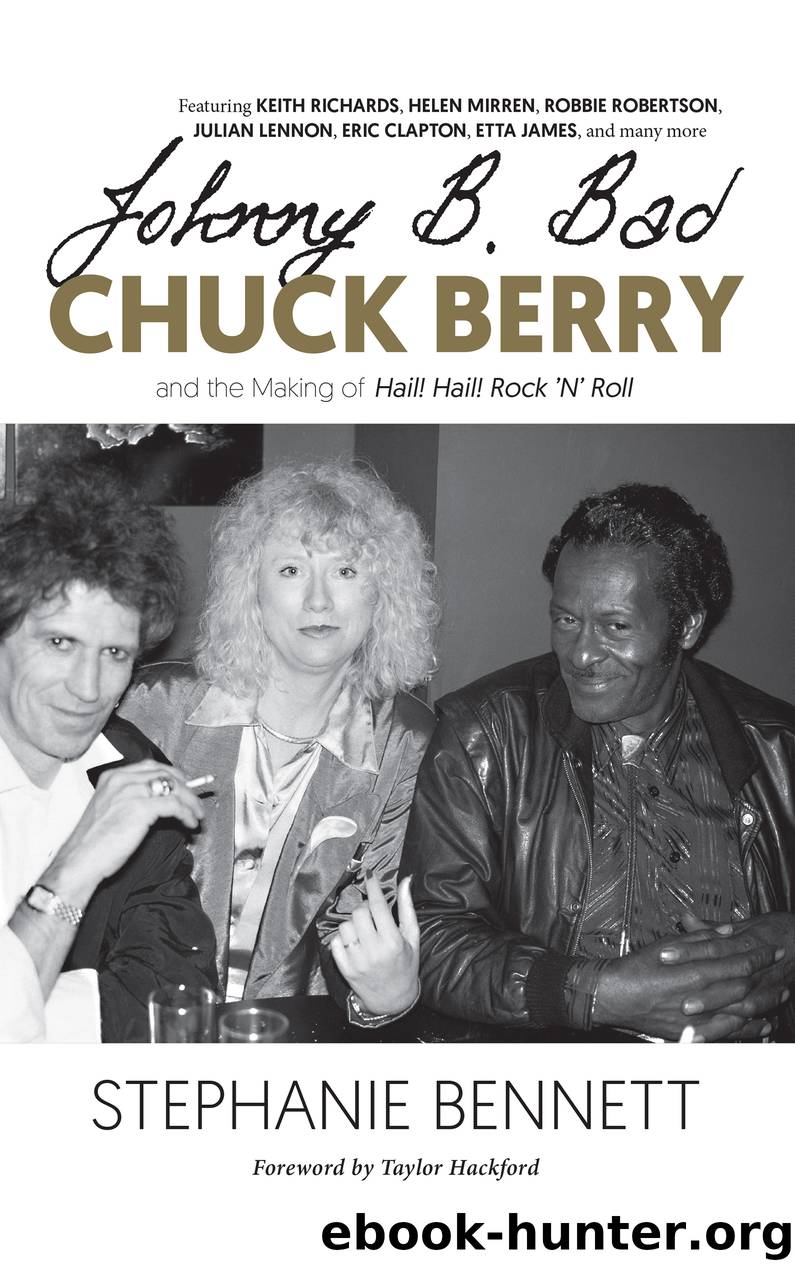
Author:Stephanie Bennett
Language: eng
Format: epub
Publisher: Rare Bird Books
Published: 2019-03-04T20:39:21+00:00
Chapter Thirteen
The Making of Hail! Hail! Rock ’N’ Roll:
Nuts & Lightning Bolts
Once Delilah Films had contracted with Universal Studios to produce a feature film on Chuck Berry and we had engaged feature film director Taylor Hackford, the sculpting of the production both creatively and its approach technically had to be developed and acted on. As Taylor started to add voice and style, and create a cinematic sculpture of what my original vision for a Chuck Berry movie might evolve into, the technical journey began. Hail! Hail! Rock ’N’ Roll was developing into a feature film which would be part concert and part documentary for theatrical release with a customary running time of approximately two hours.
TOM ADELMAN: The challenge was enormous technically. As the creative approach was unfolding, it became clear that the photographing of the movie would have to be approached with a three-prong attack. First, there would be single camera crew (on the run) documentary style shooting in places like Chicago, St. Louis, etc. Then, there would be multi-camera coverage of rehearsals for the concert which would take place at Chuck’s estate, Berry Park in Wentzville, Missouri, and include all of the guest stars who would appear as well as the backup Hail! Hail! band, led by musical director Keith Richards. And finally, there would be a full multi-camera shoot of what ended up being two concerts at the legendary Fox Theatre in St. Louis to celebrate Chuck’s sixtieth birthday. Everything would be shot on film. The documentary portion and the concert rehearsals would be filmed using Super 16mm film, and the concert itself would be shot on 35mm film. The rehearsals at Berry Park would include three cameras, and the concert would be covered using eight Panavision cameras and lenses. There would also be dollies on track, which would float stage left to stage right and back, from the perspective of the audience to focus on coverage of the stage as well. And at that time, the relatively unknown and unused in the United States, a French Louma crane would handle aerial coverage drifting high over the audience and the stage during both shows. The team of George T. Nierenberg and cinematographer Edward Lachman would handle the single camera shooting for the documentary portion, as well as roam the theater during the concert capturing events as they unfolded and specialized shots as per Taylor Hackford’s vision. Sound wise, the entire production would be recorded by Michael Frondelli at the board as the concert recordist, utilizing David Hewitt’s state of the art Remote Recording Services, Inc. company’s 24-track mobile recording facility. At that time, Remote Recording Services, Inc. was one of the best state of the art companies for recording live concert presentations around the world. The movie’s cinematographer was Oliver Stapleton, who hailed from the United Kingdom. During postproduction, the film was edited by Lisa Day with additional concert editing by Paul Justman. We assembled a top of the line, blue chip technical team for this movie in all departments.
Download
This site does not store any files on its server. We only index and link to content provided by other sites. Please contact the content providers to delete copyright contents if any and email us, we'll remove relevant links or contents immediately.
The Goal (Off-Campus #4) by Elle Kennedy(13777)
Kathy Andrews Collection by Kathy Andrews(11967)
Diary of a Player by Brad Paisley(7647)
Assassin’s Fate by Robin Hobb(6293)
What Does This Button Do? by Bruce Dickinson(6259)
Big Little Lies by Liane Moriarty(5876)
Altered Sensations by David Pantalony(5155)
Pale Blue Dot by Carl Sagan(5079)
Sticky Fingers by Joe Hagan(4253)
The Death of the Heart by Elizabeth Bowen(3676)
The Heroin Diaries by Nikki Sixx(3609)
Confessions of a Video Vixen by Karrine Steffans(3351)
Beneath These Shadows by Meghan March(3341)
How Music Works by David Byrne(3327)
Computational Linguistics and Intelligent Text Processing: 20th International Conference, CICLing 2019 La Rochelle, France, April 7â13, 2019 Revised Selected Papers, Part I by Alexander Gelbukh(3244)
The Help by Kathryn Stockett(3188)
Jam by Jam (epub)(3148)
Harry Potter 4 - Harry Potter and The Goblet of Fire by J.K.Rowling(3130)
Strange Fascination: David Bowie: The Definitive Story by David Buckley(2910)
